

Riverbank Tree Planting That Survives Its First Summer: A Step-by-Step Restoration Guide
Every spring, community groups plant hundreds of whips along eroded banks, and every September a good number of them are dead. The planting day is rarely the problem. The twelve weeks that follow are: a dry June, a watering rota that quietly collapsed, a fence that went up in July instead of February. The difference between a scheme that establishes and one that fails usually comes down to a handful of decisions made before anyone picks up a spade.
Walk the bank before you order a single tree
Spend an hour on site in winter, not in April. Note where the bank is undercut — usually the outside of a bend where the current runs hardest — and where silt has built up. Look at what already grows twenty metres back from the water; that is your best guide to what will survive. Find the debris line left by the last flood. Anything below it has wet feet for part of every winter, and a field maple planted there will sulk and die.
Check the practical side too. Where does water come from in a dry August — a hydrant, a stream, a neighbour's tap, or nowhere? Can a vehicle get within sensible carrying distance? And who owns the land, plus the grazing or fishing rights? If you are working in, over or within a few metres of a main river, you will usually need consent from the Environment Agency, Natural Resources Wales or SEPA. Apply early, because permits take far longer than planting does.
Match the species to the wet
A riverbank is not one habitat. Treat it as three zones and plant accordingly.
- Waterline and lower bank — wet most winters, often saturated: crack willow, osier, goat willow, alder, black poplar, alder buckthorn. Willows are the workhorses here. Hardwood cuttings pushed into soft ground in the dormant season cost almost nothing and root quickly.
- Middle bank, above normal flood level: alder, bird cherry, guelder rose, dogwood, hazel, hawthorn, blackthorn.
- Top of the bank and the flat beyond: oak, field maple, crab apple, wild cherry, rowan, hornbeam. These dry out in summer and will thank you for the higher ground.
Use native species of local provenance where you can; a nursery or wildlife trust working in your catchment will know what belongs there. Mix species along the length of the site rather than planting one block of alder and one of willow, so a single pest or disease cannot take out the whole scheme. Avoid ash in most of the UK while dieback continues to spread, and skip sycamore. If Japanese knotweed is on site, deal with it first — planting through it does not work.
Space them closer than feels comfortable
For bank protection, density is the point. On the lower and middle bank, plant whips 1.5 to 2 metres apart. Further back, where you are building something closer to woodland, 2.5 to 3 metres is plenty. On a badly eroded stretch, plant in tight clumps of three to five whips about 45 centimetres apart; roots knit together and reinforce the soil, and losing one stem from a clump barely matters.
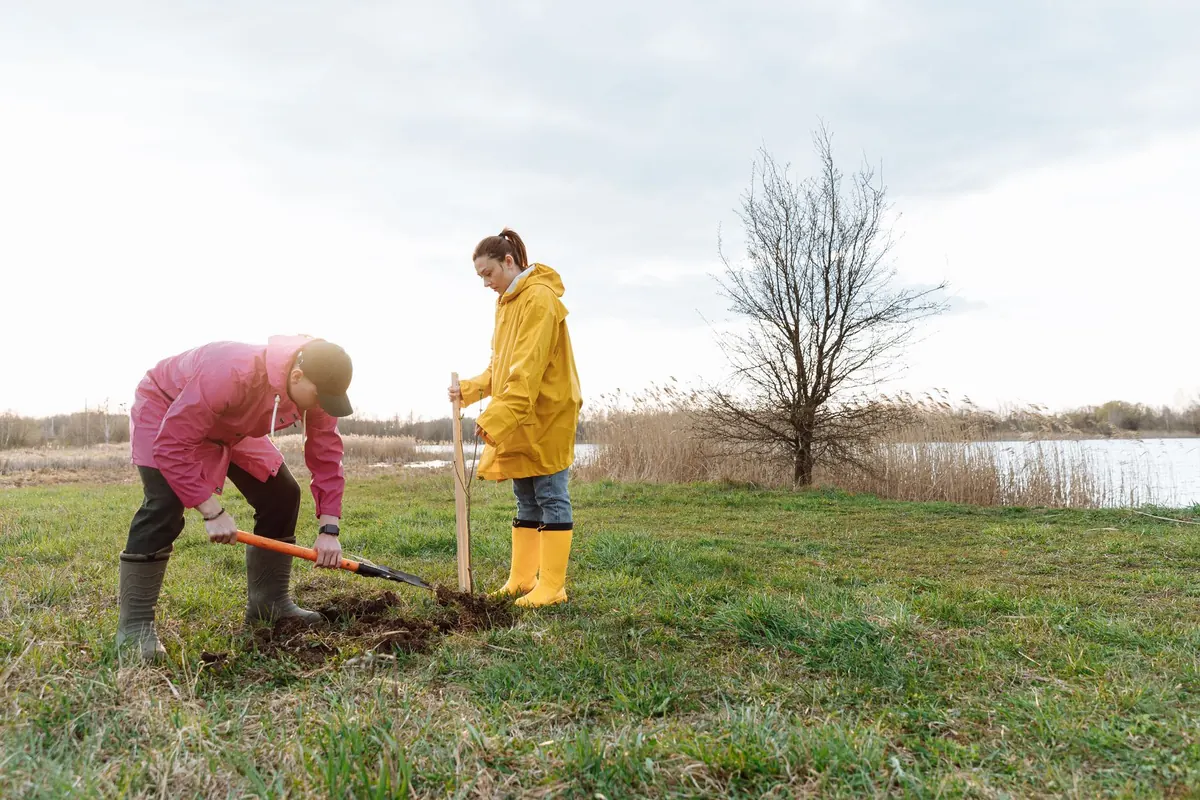
Plant with a spade, not a slit. Cut a square hole deep enough for the roots without curling them, tease the roots out, backfill in layers and firm with your heel so the tree cannot be pulled out by a light tug. The root collar — where roots meet stem — should sit at ground level. Buried too deep, the tree rots; sitting proud, it dries out.
Fence first, plant second
Grazing livestock is the most common reason riverbank planting fails. Cattle wade in, push through and rub against guards. If the site is grazed, put the fence up at least a season before the trees go in, set well back from the top of the bank so stock cannot reach over. Leave a drinking gap with hard standing if the fence cuts off the only water, otherwise the fence becomes the new erosion point.
Then protect the trees themselves. Spiral or mesh guards for rabbits and hares; taller tubes or mesh for deer. Keep half a metre of bare ground around each stem — voles work in long grass and will ring-bark whips cheerfully. Check stakes and ties after every gale. A tie cutting into a growing stem kills a tree more slowly than a rabbit, but just as surely.
Watering: deep, rarely, and on a rota that survives August
Little and often is the wrong instinct. Frequent light watering keeps roots near the surface, exactly where they are least useful in a dry spell. Give each tree a proper soak and then leave it. In a normal British summer, whips planted into a damp bank need help only in genuinely dry spells; in a hot, dry June, allow roughly ten to fifteen litres per tree per week, poured slowly around the root zone rather than against the stem. Early morning or evening is best, and never water into frozen ground.
Before you fill a can, check. Push a trowel in about ten centimetres, twenty centimetres away from the trunk. Damp soil at that depth means you can wait.
- Mulch at planting. A five to eight centimetre ring of woodchip or bark, kept clear of the trunk, cuts evaporation and suppresses the grass that competes hardest in year one.
- Split the site into watering rounds, not one long list. Twelve trees per volunteer per visit is realistic.
- Write the rota down and share it. A group chat with a pinned schedule beats good intentions.
- Tag or grid-reference the trees so volunteers can report a problem without describing "the one by the gate".
- Sort water before planting day. If there is no tap, budget for a bowser or an IBC on a trailer, and somewhere to fill it.
The rest of the first year, and the second
Keep a metre around each stem clear of grass and weeds for the first two or three summers. It sounds trivial; it is usually worth more than an extra watering. After storms, re-firm anything lifted by frost heave and straighten guards. Expect losses, and replant gaps in the next dormant season rather than writing off the scheme. Leave the brash, the dead stems and the tussocky edges alone. They are habitat, and they hide the awkward stage between a row of sticks and something that looks like a riverbank.
A first-summer checklist
- Permissions and consents confirmed in writing before work starts.
- Fence up before planting day, not after.
- Species matched to bank height, with at least four kinds in the
Photo: Thirdman / Pexels